What Is Weak AI (Artificial Narrow Intelligence)?
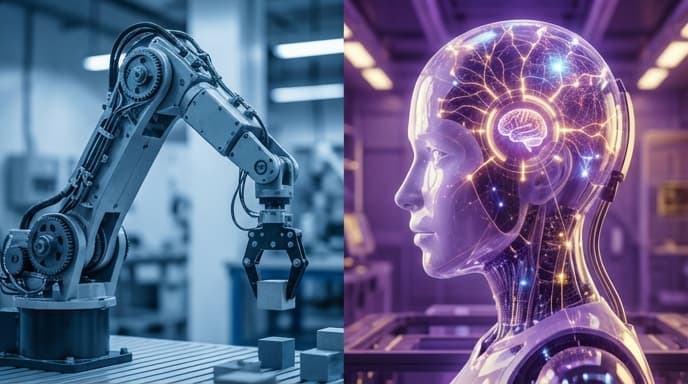
Weak AI, also known as Artificial Narrow Intelligence (ANI), is the only type of artificial intelligence humanity has successfully developed so far. It's called 'narrow' or 'weak' because it is designed and trained to perform a single, specific task. It operates within a pre-defined, limited context and cannot perform beyond its designated function.
Think about the AI you use every day:
- Voice Assistants: Siri, Alexa, and Google Assistant can understand your speech and answer questions, but they can't start writing a novel or compose music.
- Recommendation Engines: Netflix and Spotify are brilliant at suggesting what you should watch or listen to next based on your history, but they can't balance your financial portfolio.
- Spam Filters: Your email's spam filter is incredibly effective at identifying and blocking junk mail, but it can't help you write a professional email.
These systems can appear incredibly intelligent, but their intelligence is confined to one domain. They are powerful tools that excel at optimization and pattern recognition within their niche.
What Is Strong AI (Artificial General Intelligence)?
Strong AI, or Artificial General Intelligence (AGI), is the type of AI you often see in movies. It refers to a machine with the ability to understand, learn, and apply its intelligence to solve any problem, much like a human being. An AGI would possess consciousness, self-awareness, and the ability to think abstractly and creatively.
Unlike Weak AI, Strong AI wouldn't be limited to a single task. It could, in theory, learn to do anything a human can do: from driving a car and cooking a meal to writing poetry and conducting scientific research. This level of cognitive ability is the ultimate goal for many AI researchers, but it remains entirely theoretical. We have not yet created a machine that exhibits true general intelligence.
Key Differences: Weak AI vs. Strong AI
The distinction between the two is not about power but about breadth and flexibility. Here’s a simple breakdown:
- Scope: Weak AI is specialized and task-specific. Strong AI is generalized and can handle any task.
- Consciousness: Weak AI is not conscious or self-aware; it's a simulation of intelligence. Strong AI would theoretically be self-aware and conscious.
- Learning: Weak AI learns from data to improve its performance on a specific task. Strong AI could learn and adapt to entirely new, unforeseen situations, just as humans do.
- Current Status: Weak AI is everywhere. Strong AI does not yet exist.
Why Does This Distinction Matter?
Understanding the difference helps manage expectations about what current technology can do. While today's AI is transformative, it is not sentient. The ethical and societal debates surrounding job displacement, automation, and algorithmic bias are rooted in the capabilities of Weak AI. The more existential questions about machine consciousness and the future of humanity are conversations for the theoretical realm of Strong AI.
Frequently Asked Questions (FAQ)
Is ChatGPT considered Weak or Strong AI?
ChatGPT is a very advanced form of Weak AI (ANI). While it can perform a wide range of language-based tasks, its intelligence is confined to processing and generating text based on the data it was trained on. It is not conscious or self-aware.
When will we achieve Strong AI?
This is a topic of intense debate with no clear answer. Predictions range from a few decades to centuries, while some experts believe it may never be possible. Creating AGI is one of the most significant scientific challenges in history.
Can a Weak AI become a Strong AI?
No, a Weak AI cannot spontaneously become a Strong AI. They are built on fundamentally different principles. Achieving Strong AI would likely require a completely new architectural and theoretical breakthrough, not just an improvement of existing narrow systems.
Key Takeaways
- Weak AI (ANI) is specialized for a single task and is the only type of AI we currently have.
- Strong AI (AGI) is a theoretical, human-like general intelligence that is conscious and can solve any problem.
- The main difference is scope: narrow and task-specific vs. broad and generalized.
- All current AI applications, no matter how complex, are forms of Weak AI.
- The development of Strong AI remains a distant, theoretical goal.
Suggested Internal Links
What Is 'Model Collapse'? The AI Cannibalism Problem Explained
AI's 'Temperature' Setting: A Simple Guide to Creative vs. Precise Answers
Sources for Verification
This article is based on foundational concepts in computer science and artificial intelligence. For further reading, consult academic resources on AI theory and publications from leading AI research institutions.