The 'Locked Box' Analogy: How E2EE Works
Imagine you want to send a valuable item to a friend. You put it in a box and lock it with a padlock, but you're the only one with the key. You send the box, and when it arrives, your friend has to send it back to you to unlock it. This is inefficient. End-to-end encryption (E2EE) is like giving your friend an open padlock. They can use your open padlock to lock the box, but once it's locked, only your unique key can open it. You send them an open lock, they lock the box and send it to you, and only you can open it.
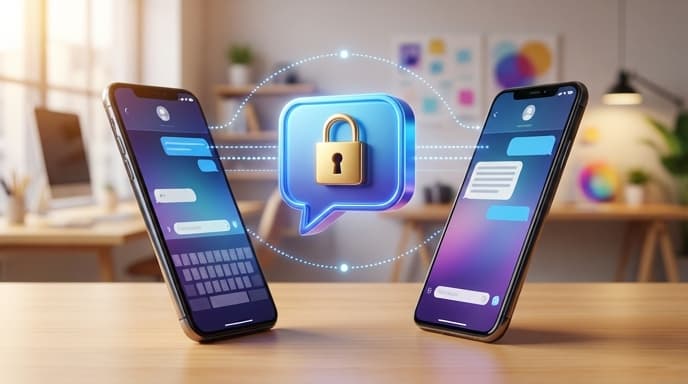
In the digital world, this is done with 'keys.' When you start a chat, you and the other person exchange public keys (the open padlocks). When you send a message, it gets locked using the recipient's public key. The message travels across the internet as a scrambled, unreadable jumble. Only the recipient's private key (their unique key) on their device can unlock and read the message. This means the message is secure from the moment it leaves your device until the moment it arrives on theirs.
E2EE vs. Encryption in Transit
Not all encryption is created equal. A common, less secure method is 'encryption in transit.' This is like a security company picking up your locked box, taking it to their warehouse, unlocking it to see what's inside, then putting it in a new locked box to deliver to your friend. The message is secure while it travels, but the company in the middle (like your email provider or social media platform) can access the content on their servers.
With E2EE, the company in the middle can see that a message was sent, but they have no way to unlock and read it. The 'keys' are only on the sender's and recipient's devices.
Why End-to-End Encryption is Crucial for Privacy
In an age of data breaches and surveillance, E2EE is a critical tool for protecting our private conversations. It ensures that:
- Service providers can't read your messages: The company that runs the app (like Meta for WhatsApp) cannot access your chat content.
- Hackers are thwarted: If a hacker breaches the company's servers, they will only find scrambled, encrypted data, not your actual conversations.
- Governments cannot easily access data: It prevents mass, warrantless surveillance of private communications.
It fundamentally protects our right to have a private conversation, which is just as important in the digital world as it is in the physical one.
Frequently Asked Questions (FAQ)
Which apps use end-to-end encryption?
Signal and WhatsApp are the most well-known examples that have E2EE enabled by default. Other apps like Telegram and Facebook Messenger offer it as an optional feature ('Secret Chats').
If a message is E2EE, is it 100% safe?
E2EE protects the message in transit. It does not protect your device itself. If your phone is compromised with malware or if someone gets physical access to your unlocked phone, they can still read your messages. It also doesn't protect the metadata (who you talked to and when).
Why don't all services use E2EE by default?
Some companies prefer to have access to user data for advertising, content moderation, or developing new features. Implementing E2EE can also be technically complex and may limit certain features like searching your chat history on a new device.
Summary: Key Takeaways
- End-to-end encryption (E2EE) ensures only the sender and recipient can read a message.
- It works using a system of public and private keys, like sending someone an open padlock.
- Unlike weaker encryption, E2EE prevents the service provider from accessing message content.
- It is a vital technology for protecting digital privacy from hackers and surveillance.
- Apps like Signal and WhatsApp use E2EE by default to secure your conversations.